Saying Goodbye
We all have to go through it at some point in our lives.
Not something you want to think about. And nothing really prepares you.
Saying goodbye to someone you love.
Funerals.
And Indians and funerals?
There are age-old traditions.
My mom passed away almost 20 years ago in Ahmedabad, India.
She lived in the U.S. but was visiting India when she developed pneumonia. She was already suffering from pulmonary fibrosis and apparently the air and pollution were too much for her lungs.
I rushed to India when I heard she was on a ventilator.
She passed away a few day later.
I came to America when I was only two. And although I had visited India many times and had family there, nothing prepared me for the day my mom died.
Or the days that followed.
I was 41. Younger, yes. But very much an adult.
It didn’t seem to matter.
My mom had just died.
Okay. Take it in. Breathe.
Things were happening around me.
Some uncles and aunties were making arrangements. But no one asked me anything.
I had no say.
I was grieving, overwhelmed and completely out of my element.
It was surreal.
I said goodbye to my mom as she was being wheeled through the garage of the hospital.
The garage.
Not realizing that would be the last time I would see her.
The cremation.
I wasn’t allowed to go.
Men only.
My mother was being cremated, and I – her daughter – could not be there.
Religion? Culture? Old family traditions?
I have no idea.
You see, when you’re surrounded by elders with old beliefs, you learn not to question. You go with the flow.
So the rest of the women and I went to an auntie’s home to shower and wait.
Weird.
I don’t remember words of comfort or condolences.
I just remember being numb from the entire experience.
Eventually, I came home and resumed life with my family.
But the reality of my mom’s death did not sink in.
It took me years to grieve her passing.
Maybe because it was sudden Maybe because I was young or maybe just maybe because the family traditions did not allow me to say a proper goodbye.
I’ll never know.
Fast forward to 2025.
My father passed away.
This time, we were in the U.S. I attended the funeral and witnessed his cremation.
Progress.
Well, sort of.
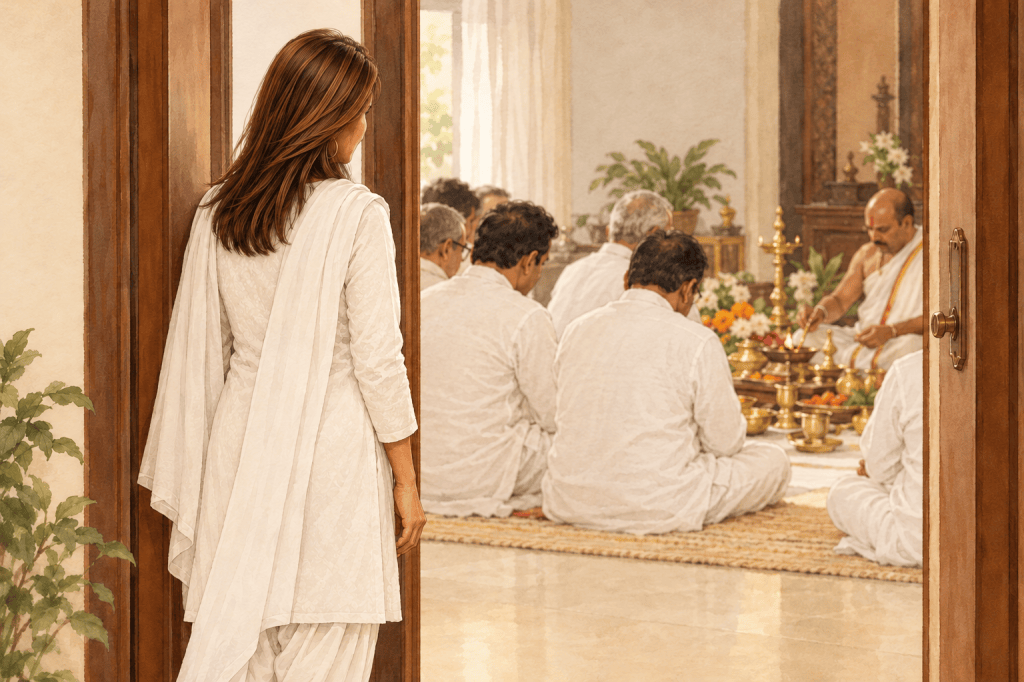
During the funeral puja, I was excluded.
Here we go. Again.
Only the son.
What?
Why?
How was it 2025, and we were still following a tradition that made room for a grieving son but not a grieving daughter?
My brother made the funeral arrangements, so once again I had no say.
And so, I felt like a guest at my own father’s funeral.
I wish I’d understood what was happening in the moment. But my mom’s was so different that I had no idea what to expect this time.
Partway through, I did have the wherewithal to ask my aunt if I could have a role in the puja.
And if the priest even knew I existed.
She, God bless her, walked over and whispered to the priest that my dad had a daughter with three sons.
To which the priest said, “Ok, we’ll call them towards the end.
More progress.
But by then, most of the ceremony was over.
That’s how traditions keep going.
You’re grieving. Overwhelmed. In shock.
You’re hardly in the mood to question your elders.
Or debate the priest.
So you follow.
The elders know.
The priest knows.
This is how it’s always been done.
And before you know it the day is over. You have once again gone along with an age-old tradition that makes no sense to you.
Because no one asks why.
Why couldn’t I go to my mother’s cremation?
Why couldn’t I sit for my father’s puja?
Was I somehow less their child because I was their daughter?
I don’t think so.
I’ve since learned that these restrictions aren’t universal across Hindu traditions.
Which makes me question them even more.
I can’t go back and change either of those days.
But maybe I can help change the experience of someone else.
The funeral, the cremation, even the puja – they give us something to do with our grief.
A chance to be there.
To say goodbye.
To begin processing what just happened, surrounded by family and friends.
And women are supposedly the more emotional ones.
Okay, so why exclude us from the very things that might help us grieve?
I feel cheated out of those moments.
And I wish I’d questioned.
That I could ask to be there.
That being a daughter didn’t mean I had to stand on the side.
Because I was saying goodbye to my parents.
To Desi or Not To Desi.


Leave a Reply